We have to be honest with ourselves. Not a single one of us wants any form of emergency to happen in our office or under our care, but that alone does not shield or even prevent it from happening. Not one of us can say an emergency will never happen to us. We can screen and assess and choose our patients we treat which are all great things, but that has nothing to do with unforeseen issues. We can't prevent someone from walking into our lobbies that we have never seen before and delivering a nicely packaged mega code right to our front door.
I don't hear it talked about much, but I believe that dealing with an emergency in our own offices hits with a different punch than emergencies that present to an emergency department or even an urgent care. I feel I can even say the same thing for EMS/Paramedics compared to us. When we are treating a patient, we have often shared several experiences with that patient prior to that point. For many of us, we don't just know the patient. We know their spouse, siblings, parents, kids, or maybe their entire extended family. We aren't responding to a call for a code for someone that we don't know. We frequently have emotional ties to our patients. Beyond that, we aren't working in an environment where death as an outcome is an accepted possibility. Please don't get me wrong. I am not saying ED providers are calloused and have things easy. What I am saying is that when faced with an emergency for a patient IN our care, there is no escaping the heaviness of the elements crossing a provider's mind such as:
- What if this turns out really bad or the patient doesn't make it?
- Is the board going to strip me of my sedation license/anesthesia permit or suspend/revoke my dental license?
- What if the family sues me and I can't work anymore and provide for my family?
- What if I do everything right but still get destroyed on social media/news and all my patients leave?
We've all been to conferences where they wait until the end to go over all the horror situation cases and suddenly everyone wakes up and pays attention because all of us are so relieved in thinking, "That hasn't happened to me!" As you see the slides and you see the fallout from the decisions that were made, it's easy to sit in a comfortable stress-free environment and say:
"Oh, that was the total wrong move..."
"They should have done..."
"Well, I would never..."
Yet there's that little tinge of spidey sense and that small voice in the back of our heads that says, "Would I be able to handle whatever is thrown at me?"
When reality hits and we are not in a comfortable environment and instead we are right there with our patient as an emergent situation unfolds, absolutely everything weighs down on us. Immediately.
It's subtle at first, then everything accelerates. Voices change. Movements often become faster and the challenge of what feels like chaos ensues. Despite years of training, something very predictable begins to happen inside the human brain:
Cognitive capacity starts to fail. This is not a theory. It is one of the most consistently demonstrated truths across aviation, emergency medicine, and human performance science.
The Human Brain Under Stress
In high-acuity environments, clinicians are forced to process multiple streams of information simultaneously: vital signs, medications, team communication, procedural steps, the H's and T's, all under time pressure. This creates what is defined as cognitive load: the total demand placed on working memory at any given moment.
The problem is simple: working memory is limited.
Classic and modern cognitive science both demonstrate that humans can only actively manage a small number of elements at once, typically in the range of 5-7 items. When task demands exceed that capacity, cognitive overload occurs, and performance degrades.
In the emergency setting, this has direct consequences. We see increased error rates, delayed decision-making, loss of situational awareness and reduced hand skills.
Layer on top of that the physiological effects of stress such as reduced memory, impaired attention, and narrowed perception, and the situation becomes even more concerning.
Even highly trained professionals are not immune. Under stress, experts do not rise to the occasion. Rather, they fall to the level of their training and systems.
Organization Is Not Optional. It Is Foundational.
If cognitive overload is the problem, then the solution must be structural.
I'm not reinventing the wheel here. This has been proven time and time again. Aviation faced this problem nearly a century ago: highly trained pilots make preventable errors during emergencies. Their solution was not more training, but rather better systems. Specifically:
- Standardized checklists
- Clear procedural organization
- Cognitive aids designed for real-time use
Put these all together and we get a measurable and sustained improvement in safety.
Checklists are now recognized as tools that ensure simple standards are applied every time, reducing variability and preventing omission errors.
More importantly, they shift thinking from improvisation to rule-based execution, which is exactly what is needed under stress.
Because in a true emergency, we do not want clinicians "figuring it out" or relying on memory that potentially could be faulty. We want them executing something that already works.
Cognitive Load Reduction = Improved Outcomes
When you reduce cognitive load, three critical things happen:
- Working memory is preserved for high-level decisions
- Situational awareness improves
- Error rates decrease
This is measurable. High task complexity and multitasking increase cognitive load and correlate with higher error rates and reduced performance. Conversely, structured systems (eg. checklists, cognitive aids, and organized workflows) serve as external memory, offloading the brain and allowing clinicians to function at a higher level.
You don't make people better under stress. You make the system easier to execute.
Why We Created CodeKit
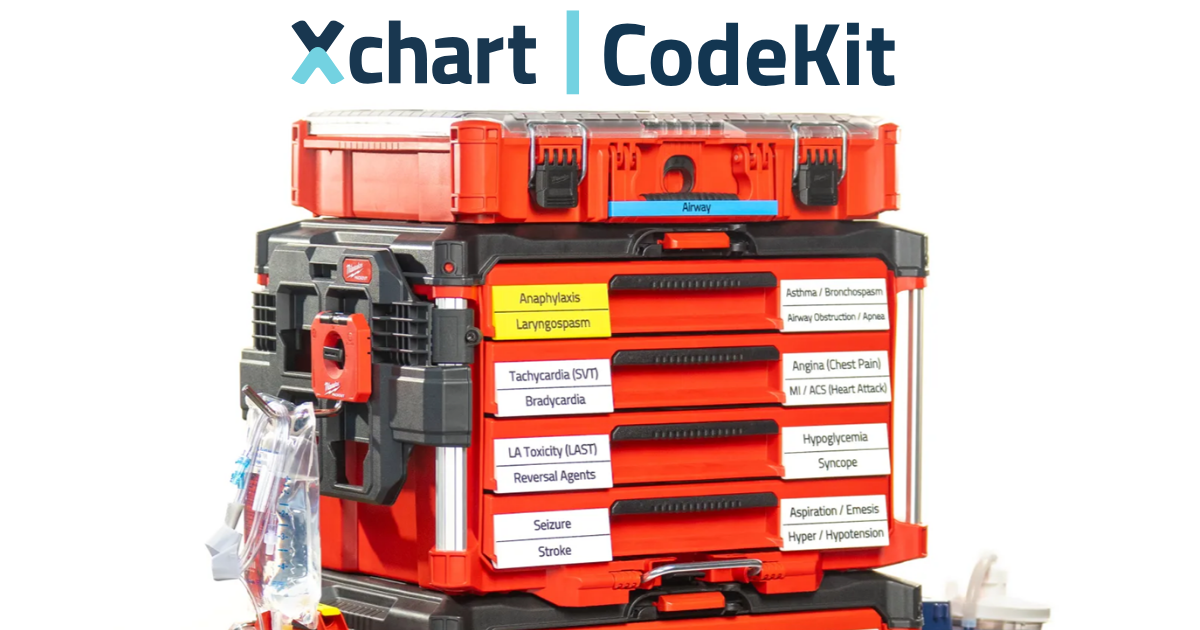
What I've outlined above represents the exact set of problems we aim to solve. CodeKit was not designed as a storage solution. It was designed as a human performance solution.
Every element of the CodeKit structure is designed around a solution for potential team breakdowns during emergent situations, including:
- Visible color coded labeling
- The core is organized by emergency type
- Algorithms are paired with the emergency type
- Necessary drugs and syringes are coupled with each emergency
- Low to high skill level teammates can follow the system
None of us would ever willingly deal with an emergency completely alone, especially if we're surrounded by team members. Emergencies are a team event. We have to rely on our teammates around us. Let me be frank for a second. There are some assistants that are absolutely amazing and you feel you can walk into any battle with them and there are some assistants that, well, let's just say every team needs a waterboy. Well-constructed systems are the only things (other than more experience and additional training) that can even the playing field. We have all heard of errors occurring during emergencies. If we create systems that reduce the possibility of those errors by every member of our teams, those systems will massively serve us in those emergent situations.
Five Things We Expect From Systems:
- Reduce thinking
- Increase clarity
- Enable action
- Reduce the chance of errors
- Increase efficiency
When a team member can grab a kit labeled "Anaphylaxis" and immediately have the medications and the algorithm and the syringes, all in the kit and ready to go as well as clearly labeled, something powerful happens: the stress of the teammates decreases as now they don't have to spend precious time pulling from memory which drug names or which specific syringe is used/needed. They also don't have to find the algorithm notebook and flip to the right algorithm. Teammates have confidence. All teammates. With CodeKit, they will now have confidence to execute the steps needed and within the necessary timeline of the emergency event. This in turn reduces stress and has the potential to allow for clearer thinking.
That is why we built CodeKit. Not just because it is helpful. We believe CodeKit is necessary. We all know prevention is our best emergency preparation, but we cannot eliminate all chances of an emergency occurring. I personally want to adopt the use of anything that will improve the chances of a positive outcome in an emergency. I want for my patients and I know that is what you want for your patients as well. It's easy to say we all want organization, but actually executing that and putting it together is an entirely different thing. We want to serve our fellow colleagues and providers with CodeKit, a set of tools and services built as a system of organization that instills confidence in you and your team while saving a lot of time and effort.
Emergency preparedness is ultimately a systems problem. If your practice is evaluating its emergency response capabilities or maybe you'd like to compare notes, please reach out.
Be safe out there!
Travis V. Coulter DDS
Xchart.com | Clinical Director
References
- Vella K, et al. Application of cognitive load theory in emergency medicine. 2021.
- Boere K, et al. Cognitive load and working memory limitations in high-stakes environments. 2024.
- Clay-Williams R, et al. Checklists in aviation and healthcare. 2015.
- Guy IA, et al. Lessons from aviation checklists and decision-making tools. 2022.
- Rash CE, et al. Effects of stress on cognitive performance in aviation.
- Stress in aviation industry - impact on cognition and performance.
- Multitasking and cognitive overload in healthcare professionals. 2025.